24/7 grease trap & interceptor service

Grease Trap Cleaning Los Angeles CA

We provide grease trap cleaning Los Angeles CA restaurants, food halls and institutional kitchens can count on, from small under-sink units in Koreatown to multi-thousand-gallon interceptors near the convention center. Our crews pump every compartment, scrape the walls and baffles, and leave a signed manifest you can hand to a city inspector. To schedule a visit or ask a question, call (424) 573-8021.

Call (424) 573-8021Dispatch answers day and night
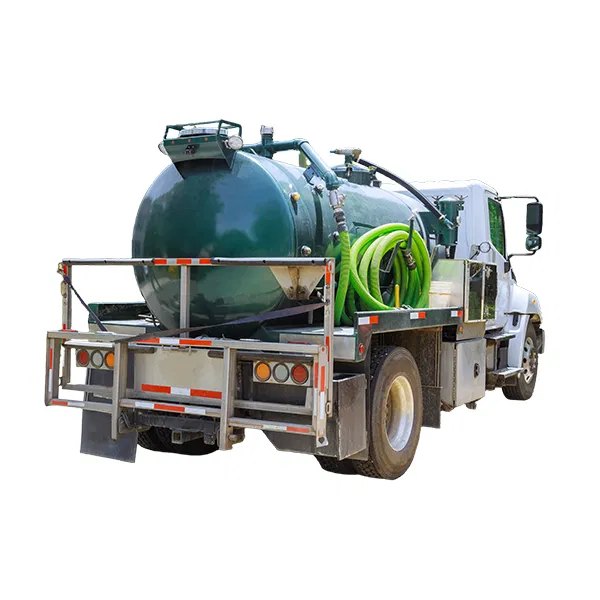
Grease Trap Cleaning Los Angeles CA vacuum pump truck with suction hose ready for a kitchen grease trap pump-out

Grease layer close to the outlet tee? A dispatcher can help right now.

Call (424) 573-8021

Grease Trap Cleaning Los Angeles CA under the LASAN FOG Control Program

Inside the City of Los Angeles, commercial grease is regulated by LA Sanitation and Environment (LASAN) through its FOG Control Program, which sits within the city's industrial waste pretreatment program. The legal backbone is Los Angeles Municipal Code Section 64.30, Industrial Wastewater Disposal, together with the Board of Public Works' Rules and Regulations Governing Disposal of Industrial Wastewater into Publicly Owned Treatment Works. A food service establishment that discharges grease is expected to hold an Industrial Wastewater Permit, pay an annual inspection and control fee, and allow city staff to enter, inspect and sample.

Section 64.30 requires every food service establishment to implement and demonstrate best management practices, and newly constructed kitchens are subject to gravity grease interceptor requirements, as are many substantial remodels. Units must meet the city plumbing code, and the director may grant conditional waivers or variances where a kitchen produces little grease or lacks room. Commercial garbage grinders are prohibited unless the city expressly allows one.

LASAN's maintenance guidance is built around the familiar 25 percent rule: a grease control device should be pumped before floating grease and settled solids reach a quarter of its liquid depth. Waiting longer lets grease escape into the public sewer, where it hardens and contributes to blockages and sanitary sewer overflows. Regular grease interceptor pumping on a schedule matched to your cooking volume is the simplest way to stay under that line.

Records matter as much as the pump-out. Section 64.30 requires dischargers to keep monitoring records for at least three years, so file every manifest, invoice and BMP log for that long. The program also supports the State Water Board's Statewide Sanitary Sewer Systems General Order, which expects sewer agencies to run FOG source control, so Los Angeles inspectors take missing paperwork seriously.

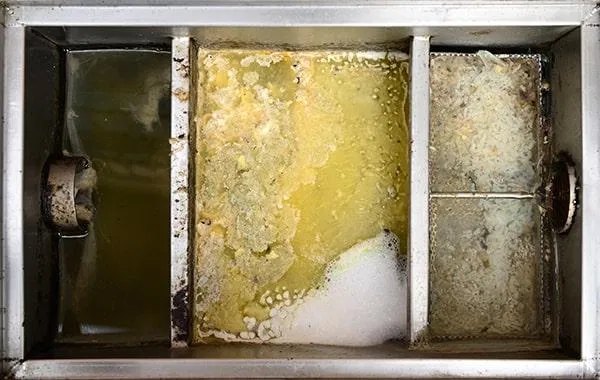
Stainless steel grease trap with baffles and separate compartments in a Los Angeles restaurant kitchen

Pump-out coming due? A single call puts you on the route.

Call (424) 573-8021

Los Angeles grease trap demand by neighborhood

Koreatown runs some of the hardest-working traps in Los Angeles. Tabletop Korean BBQ along Western Avenue and Wilshire Boulevard sends rendered pork belly and brisket fat to the dish pit all night, often in older buildings with little floor space. Nearby Thai Town adds curry oils, woks and deep fryers.

On the Eastside, Boyle Heights taquerias and carnicerias along Cesar Chavez Avenue and around Mariachi Plaza work with lard, carnitas drippings and trompo fat that solidifies quickly once it cools in a trap. Downtown, Grand Central Market packs dozens of stalls under one roof, Little Tokyo's ramen shops pour off tonkotsu broth rich in emulsified fat, and Arts District breweries and bakeries generate a mix of butter, dough and starch that settles into a heavy bottom layer.

On the Westside, the Fairfax and Melrose corridor and the Sawtelle Japantown strip mix delis, bakeries, ramen and fried chicken counters, often with under-sink traps that fill in days rather than months. Hollywood adds late-night bars and hotel banquet kitchens, while Van Nuys and Ventura Boulevards in the San Fernando Valley host strip-center restaurants that share one interceptor.

Event venues are their own category. LA Live, Crypto.com Arena and the Los Angeles Convention Center feed concession stands and banquet kitchens that can produce a week of grease in one weekend. For these sites, routine grease trap cleaning is paired with extra visits around concerts, playoff runs and trade shows.
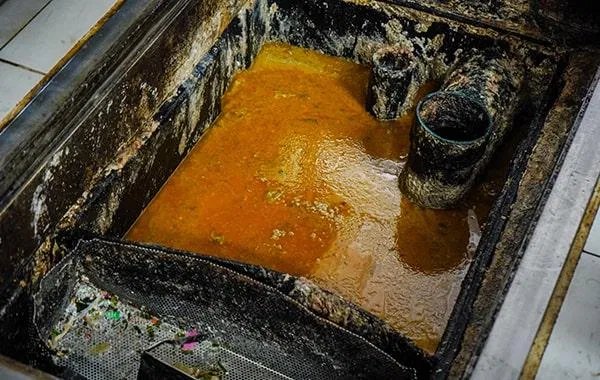
Open grease trap with a thick orange grease layer and inlet pipes at a Los Angeles taqueria

Floor sink backing up mid-service? Trucks roll day and night.

Call (424) 573-8021

Local conditions that affect a Los Angeles grease trap

Water conservation has changed how grease behaves in Los Angeles. Drought rules and low-flow fixtures mean less water moving through each drain line, so fat arrives at the trap more concentrated. Summer heat waves keep grease liquid in hot kitchens until it cools in the street sewer and sticks to the pipe wall.

Much of the city's commercial building stock predates modern plumbing codes. Older laterals in Downtown, Hollywood and the Valley may be vitrified clay with offset joints and root intrusion, and an overflowing trap pushes grease into exactly those weak spots. Winter atmospheric-river storms can also raise inflow, slowing drainage in buildings with marginal slope.

Access is the other daily challenge. Many Los Angeles restaurants sit on alleys with tight turning room, permit-only parking and busy loading zones. We plan routes around those limits, schedule early-morning or late-night service where curb space is scarce, and bring enough hose to reach interceptors buried under rear parking lots.

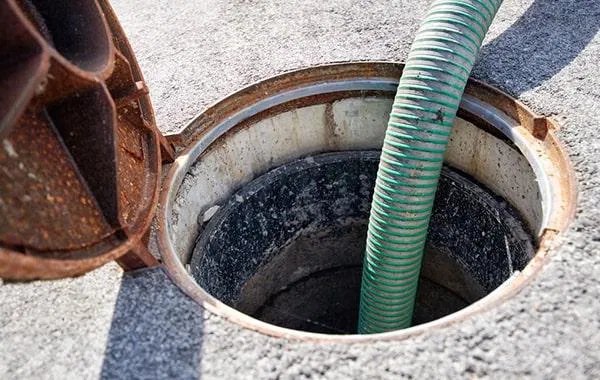
Manhole grease interceptor being serviced with a green suction hose behind a Los Angeles restaurant

FOG inspection on the calendar? Book the pump-out before it.

Call (424) 573-8021

What a Los Angeles grease trap service visit includes

Every visit follows the same order so kitchen managers know what to expect and inspectors see consistent documentation. We arrive with a vacuum truck sized for the job, confirm which devices are on the permit, and work around your prep schedule.

When we leave, you have a clean device, a clear record of its condition and a manifest ready for your LASAN file, which is what grease trap cleaning in Los Angeles should deliver.

  • Take a depth reading of the grease mat and sludge first
  • Pump all compartments and remove the solids layer
  • Scrape down walls and baffles, then clear both tees
  • Check lids, gaskets and flow paths for damage
  • Issue a manifest with gallons removed and disposal site

Prefer service after closing? Overnight crews are standard.

Call (424) 573-8021

Grease Trap Pumping in Los Angeles, CA

For small under-sink traps and indoor hydromechanical units in places like Sawtelle, Little Tokyo and Fairfax, we pump the unit completely, remove the solids basket, wipe down the baffles and check the flow-control fitting. Short, frequent visits keep small kitchens under the 25 percent mark and avoid backups during the dinner rush.

How grease trap pumping works →

Grease Interceptor Cleaning in Los Angeles, CA

Large in-ground interceptors at Los Angeles food halls, hotels and hospital cafeterias need more than a pump-out. Our crews remove the full contents, break up hardened cap grease, scrape concrete walls and baffles, and inspect the inlet and outlet tees so the device keeps separating grease the way the city plumbing code intends.

How interceptor cleaning works →

Grease Interceptor Pumping in Los Angeles, CA

Scheduled interceptor pumping suits Valley strip centers, Downtown restaurants and stadium-area kitchens that share one gravity unit. We set a recurring interval based on measured grease depth, adjust it around busy seasons, and supply a manifest each time so property managers can show tenants and inspectors a complete maintenance record.

How interceptor pumping works →

Want a complete evacuation and a signed manifest? Give us a call.

Call (424) 573-8021

Our Los Angeles grease trap service area

We cover the City of Los Angeles from the Harbor to the north San Fernando Valley, including Downtown, Koreatown, Hollywood, the Westside, the Eastside and South LA. Our trucks also run into neighboring cities across Los Angeles County, so multi-site operators can keep one schedule.

Unsure how big your interceptor is? A technician can talk it through.

Call (424) 573-8021

Grease Trap Cleaning Los Angeles CA: frequently asked questions

How do you calculate a pump-out interval for a Koreatown BBQ restaurant versus a Valley coffee shop?

We measure grease and solids depth on the first few visits, divide the depth allowed under the 25 percent rule by the depth that built up per day, and round down to a safe interval. A busy Koreatown grill may land at two to four weeks, while a Valley coffee shop with light baking might stretch to several months.

What information is on the manifest we file for LASAN?

Each manifest lists your business name and service address, the date, the device serviced, gallons removed, the grease and solids levels we measured, the liquid waste hauler's information, the driver's signature and the facility where the waste was taken. Keep it with your permit file, since LAMC Section 64.30 calls for monitoring records to be kept at least three years.

Our interceptor is overflowing into the parking lot behind our Hollywood restaurant. What should we do?

Stop running dish machines and sinks that drain to the device, keep grease away from any storm drain inlet with absorbent or a berm, and call (424) 573-8021 for emergency pumping. Spills that reach the street or storm drain should also be reported to the city, and we can document what we found for that report.

Does LAMC Section 64.30 really ban garbage grinders in commercial kitchens?

Section 64.30 prohibits garbage grinders for discharging food waste from commercial kitchens unless the city expressly allows one. Ground food adds solids that sink to the bottom of the interceptor and shorten the time between pump-outs. Most kitchens that remove a grinder and switch to scraping plates into bins see their solids layer build more slowly.

Could reworking an Arts District warehouse kitchen mean installing a gravity grease interceptor under LASAN rules?

It can. LASAN treats new construction and substantial remodels of existing food service establishments as points where a gravity grease interceptor may be required, and the city's industrial waste pretreatment page lists a project value threshold. Talk with LASAN and your plumber early, since an outdoor interceptor affects site layout, excavation and permit timing.

Can a stall at Grand Central Market share an interceptor with its neighbors?

Many food halls route several vendors to a common interceptor managed by the property owner. In that setup the owner usually schedules and pays for pumping, while each vendor still follows BMPs such as drain screens and dry wiping. If one stall cooks heavily, the shared unit fills faster for everyone, so vendors and management should agree on the interval.

How do tonkotsu ramen kitchens in Little Tokyo load a grease trap differently?

Long-simmered pork bone broth holds fat in an emulsion that does not float as cleanly as fryer oil. When that broth is dumped hot, some of the fat passes through a small trap before it separates. Cooling stock before disposal, straining solids and booking more frequent pump-outs help a ramen shop stay within its limits.

Do concession kitchens near Crypto.com Arena need extra service during playoff runs?

Usually, yes. Back-to-back games and concerts at Crypto.com Arena and LA Live can produce more fryer and grill waste in a few days than a normal month. We recommend booking grease trap cleaning right after a heavy stretch of events so the device is back to full capacity before the next homestand.

What does the annual Industrial Wastewater Permit fee from LASAN cover?

The city charges an application fee when a food service establishment first obtains its Industrial Wastewater Permit, then an annual inspection and control fee that funds program inspections and oversight. The amounts are adjusted each year by the city, so check the current schedule with LASAN. Our pumping charges are separate from any city fees.

Why does the State Water Board's sewer order matter to a Los Angeles restaurant?

The Statewide Sanitary Sewer Systems General Order requires sewer agencies to reduce overflows, and FOG source control is part of that effort. That is a large part of why the city inspects restaurants and asks for maintenance records. A well-kept trap and complete paperwork help show that your kitchen is not contributing to overflows in the Los Angeles public sewer.

How do aging clay sewer laterals in Hollywood buildings affect grease problems?

Older clay laterals often have offset joints, roots and sags where grease that slips past a trap can collect and harden. Once that happens, even a freshly pumped trap may drain slowly because the restriction is downstream. If backups continue after service, a camera inspection and hydro jetting of the lateral can show whether the pipe itself is the bottleneck.

Can you service a Westside restaurant whose only access is a narrow alley?

Yes. Many Westside and Sawtelle restaurants sit on tight alleys with limited turning room. We choose the truck size for the site, run extra hose when the interceptor is far from the curb, and schedule early or late visits to avoid blocking deliveries or trash pickup. Tell us about gates, low clearances and parking rules when you call.

Truck, crew and manifest, all arranged in one phone call.

Call (424) 573-8021

Grease trap service in cities near Los Angeles

We also serve restaurants and commercial kitchens in cities surrounding Los Angeles. Choose a city below to see how local sewer rules and business districts shape our service there.

Sinks draining slowly at the dish station? Call before it overflows.

Call (424) 573-8021
Call now